

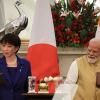
India and Indonesia have taken a major step toward strengthening their maritime strategy in the Indian Ocean by agreeing to jointly develop Indonesia's Sabang Port. The project will modernise the port with advanced infrastructure while expanding India's strategic presence in the region. The agreement was signed during Prime Minister Narendra Modi's visit to Indonesia following talks with President Prabowo Subianto.
Sabang Port is strategically located at the entrance to the Malacca Strait and lies only about 100 miles, or nearly 160 kilometres, from Indira Point in India's Andaman and Nicobar Islands and the upcoming Great Nicobar Port project. Its location places it at one of the world's most significant maritime chokepoints.
Ships departing from Chennai travel across the Bay of Bengal and the Andaman Sea before entering the Malacca Strait. Centuries ago, the spice trade between India, China and Southeast Asia transformed this sea route into one of the world's most important commercial corridors. Today, the Malacca Strait connects the Indian Ocean with the South China Sea and remains one of the busiest shipping lanes in the world.
Nearly 25 percent of global maritime trade passes through the Malacca Strait every year. Goods worth approximately 2.8 trillion US dollars, including crude oil, natural gas, coal, palm oil, machinery and consumer products, are transported through this route annually. Singapore, located at the southern end of the strait, is regarded as one of the world's most important ports.
For India, the Malacca Strait serves as a vital maritime lifeline. A significant share of India's trade with China, Japan, South Korea and other East Asian countries moves through this corridor. Petroleum products, coal, machinery and container cargo all depend heavily on this route. The strait also plays a crucial role in strengthening India's Act East Policy and expanding connectivity with Southeast Asia. From an energy security perspective, the route is equally critical, as large volumes of crude oil and natural gas from West Asia pass through the Malacca Strait before reaching East Asian markets.
The Malacca Strait is even more significant for China, whose energy security and export-driven economy depend heavily on uninterrupted access through the waterway. A substantial portion of China's imported crude oil and natural gas from West Asia and Africa travels through the strait, while a major share of its exports also relies on the same maritime route.
Recognising this vulnerability, then Chinese President Hu Jintao referred to the "Malacca Dilemma" in 2003, warning that any conflict or blockade affecting the strait could severely disrupt China's energy supplies and international trade.
Sabang Port, located in Indonesia's Aceh Province at the western entrance of the Malacca Strait, offers a strategic position from which maritime activity can be monitored more effectively. India has sought to strengthen its presence in this region for several years. Although both countries established a framework for cooperation on Sabang Port in 2018, the latest agreement is expected to accelerate the project's development.
At the same time, India is rapidly advancing the Great Nicobar project in the Andaman and Nicobar Islands. The ambitious development includes an international transshipment port, a greenfield airport, a power plant and a modern township. The objective is to establish India as a major maritime and logistics hub close to the Malacca Strait.
Strategic experts believe that the combined development of Sabang Port and the Great Nicobar project could provide India with enhanced strategic access on both sides of the Malacca Strait. The partnership is also being viewed as a response to China's Belt and Road Initiative and its String of Pearls strategy. As China expands its presence at ports such as Gwadar in Pakistan, Hambantota in Sri Lanka and Kyaukphyu in Myanmar, Sabang Port could emerge as a crucial strategic asset for India in maintaining regional balance and strengthening its maritime influence across the Indian Ocean.
About The Author


.jpg)





Comment List